
The E-400 Folding Impeller
Fits through a 6" cap. Opens to 12" or 13" inside the tote.
Full-size mixing through a standard tote opening
Most IBC totes have a 6″ screw cap. A conventional impeller big enough to mix 275 gallons will not fit through it — which is why so many plants end up pumping product out to a tank. The E-400 folding impeller was designed around that opening.
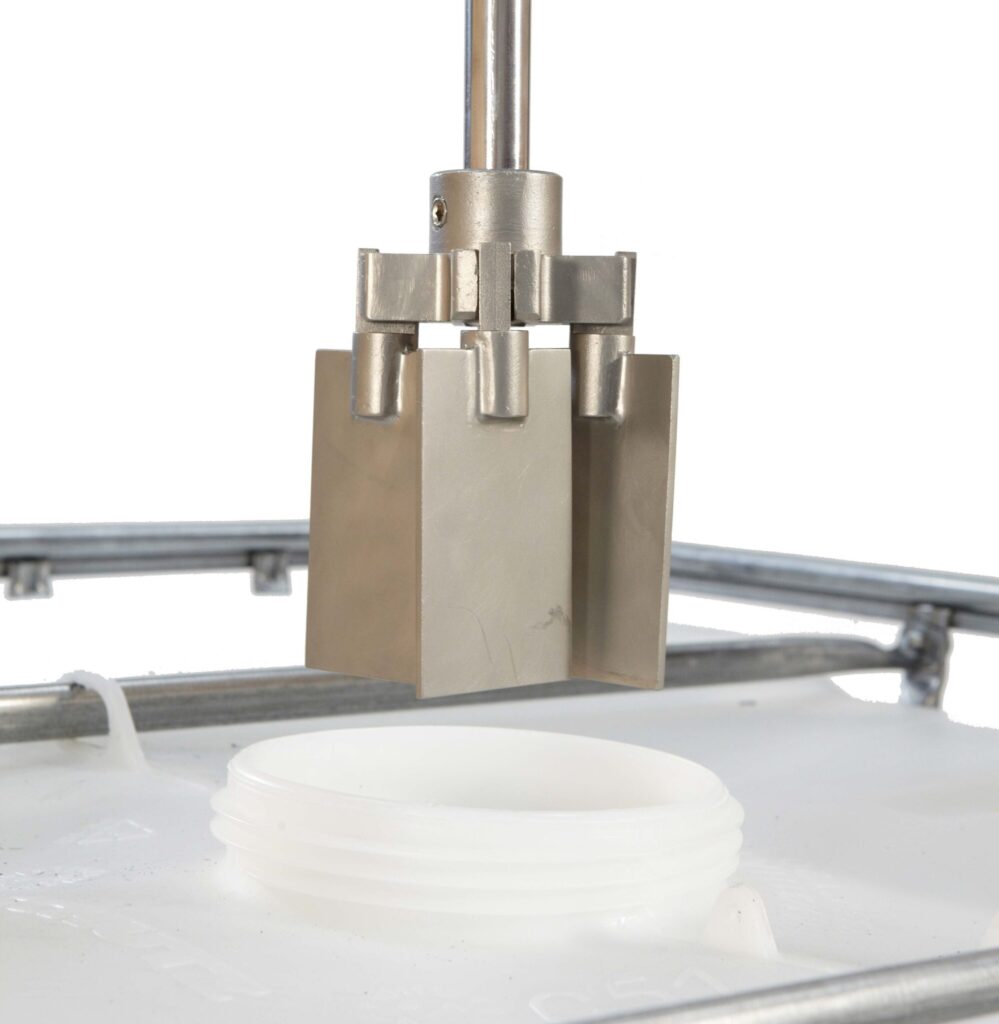
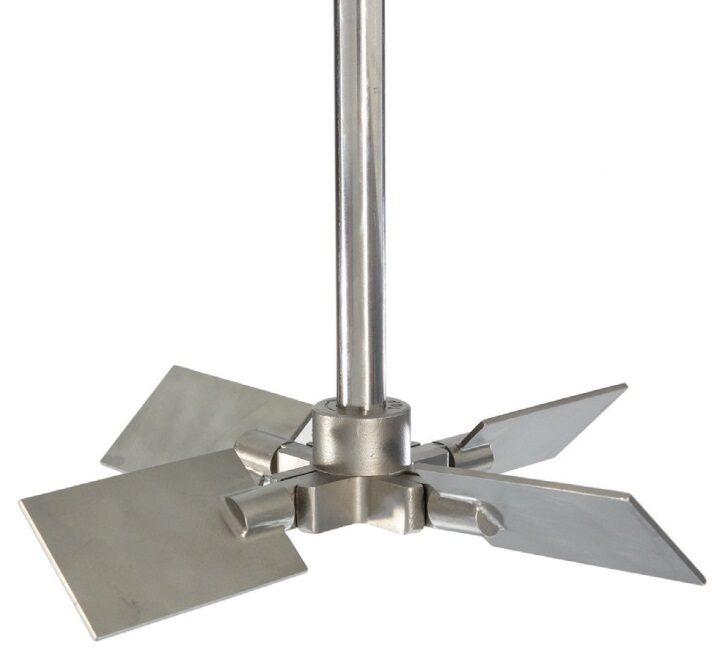
Its four blades fold flat against the shaft so the assembly passes through the cap. Once the mixer starts, the blades swing open under rotation to their full diameter — 12″ on LBC-100 models, 13″ on LBC-200 models — giving the turnover needed to re-suspend settled solids or blend viscous liquids in the original container. Stop the mixer, and the blades fold back for withdrawal.
At a glance
- 4-blade folding design; passes a 6" opening
- 12" (LBC-100 / 100A) or 13" (LBC-200 / 200A) open diameter
- Welded to a 3/4" (19.05 mm) shaft; 316 stainless steel as standard
- Polypropylene or PVDF versions for corrosive products
- Fitted to all LBC low-speed gear-drive IBC mixers, electric and pneumatic

Closed and open
The same impeller, before and after the blades deploy. On the left it is folded to pass through the tote’s 6″ screw cap; on the right it is at full operating diameter inside the container.
How it works
- 1. Fold — with the mixer lifted, the blades hang closed against the shaft
- 2. Insert — lower the shaft through the tote's 6" cap opening
- 3. Clamp — seat the bridge on the tote frame and close the toggle clamps; the safety interlock is now made
- 4. Mix — start the mixer; the blades open under rotation and mixing begins
- 5. Remove — stop, unclamp and lift; the blades fold for withdrawal
Single or dual impellers?
One E-400 is sufficient for most low- and medium-viscosity products. A second impeller is fitted:
- In all cases where the product viscosity is above 4,000 cP
- For water-based inks
- When a powder hopper is used and viscosity is above 3,000 cP
- For thixotropic or shear-thinning products — thick at rest, thinner once mixed — which generally need two impellers to get started
The second impeller is normally positioned about half an impeller diameter below the liquid surface, so the upper impeller draws the surface down while the lower one works the bulk. This gives full top-to-bottom turnover in the tote.
Low-level radial impeller
Where a tote is emptied right down to the bottom and the product carries a high solids load, a low-level radial impeller on a long shaft can be fitted close to the tote floor to keep solids moving as the level drops. Tell us if you routinely run totes to empty.
Materials and finishes
| Option | When to specify |
|---|---|
| 316 stainless steel (standard) | Most chemicals, coatings, inks, water-treatment products and food-grade duties |
| Polypropylene (PP) | Products that attack stainless steel — certain acids, chlorides and bleaches |
| PVDF | More aggressive chemistries or higher temperatures than PP allows |
| Polished / electroplated 316 SS | Food and pharmaceutical duties requiring a specified surface finish — tell us the Ra value you need |
In all cases the impeller is welded to the shaft. Standard shafts and impellers are not polished. You know your product best: if you are unsure whether 316 stainless steel is suitable, tell us the chemistry and we will advise.
Impeller size by mixer model
| Mixer | Drive | Impeller | Open diameter |
|---|---|---|---|
| LBC-100 | Electric, 1 HP | E-400 folding | 12" |
| LBC-100A | Air, 1 HP | E-400 folding | 12" |
| LBC-200 | Electric, 2 HP | E-400 folding | 13" |
| LBC-200A | Air, 2 HP | E-400 folding | 13" |
Frequently asked questions
Will the impeller damage the tote?
No. The E-400 opens well clear of the tote walls, and the bridge holds the shaft centred in the opening.
Can I use it for polymer mixing?
Yes — an LBC-100 with the 12″ folding impeller is the standard recommendation for polymer make-down in totes.
Does it work with a powder hopper?
Yes. When adding powder through a hopper into a product above 3,000 cP, dual impellers are fitted.
For a quote, tell us the product, its viscosity and specific gravity, the tote size, whether you need electric or air, and the mixing objective. Our engineers will recommend the right model and impeller arrangement.